
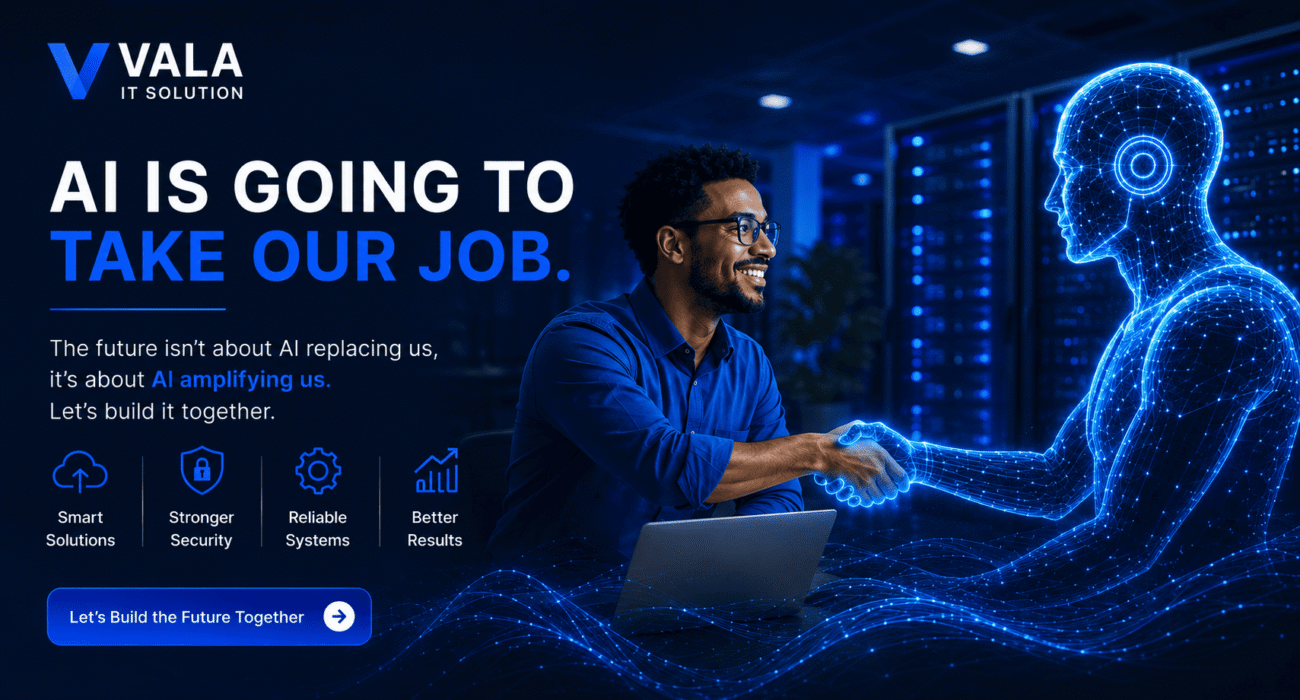
Let’s address the biggest concern surrounding Artificial Intelligence.
Yes, this article was written by a human—with AI assisting in research and refinement. That’s exactly the point.
AI isn’t replacing humans. It’s empowering them.
The real question isn’t “Will AI take my job?”
It’s “Am I learning how to work with AI?”
The Reality: AI Is Transforming Jobs, Not Eliminating Them
Every major technological revolution has changed the way people work. From the Industrial Revolution to the Internet, technology has replaced repetitive tasks while creating entirely new opportunities.
AI is following the same path.
According to the World Economic Forum, AI and automation are expected to displace approximately 85 million jobs, while creating nearly 97 million new roles worldwide.
This isn’t the end of work—it’s the beginning of a new way of working.
How AI Is Changing the Workplace
AI excels at handling repetitive, time-consuming tasks such as:
- Data entry
- Content drafting
- Grammar correction
- Report generation
- Scheduling
- Customer support automation
Tools like ChatGPT, Grammarly, Canva, Notion AI, and many others allow professionals to complete routine work faster and with greater accuracy.
Instead of replacing people, these tools free up time for more meaningful work.
The Shift: From Repetitive Work to Human Expertise
As AI handles routine tasks, human roles are becoming more focused on areas where machines still struggle.
These include:
- Strategic decision-making
- Creative thinking
- Leadership
- Communication
- Emotional intelligence
- Complex problem-solving
The future belongs to professionals who combine technical skills with uniquely human abilities.
New Career Opportunities Created by AI
The growth of AI is creating entirely new professions, including:
AI Trainers
Teaching AI systems how to understand language, recognize patterns, and improve responses.
AI Quality Analysts
Testing AI-generated results for accuracy, reliability, and consistency.
AI Ethics Specialists
Ensuring AI is developed and used responsibly, fairly, and without bias.
Data Analysts & AI Strategists
Turning AI-generated insights into practical business decisions.
These careers barely existed a few years ago, yet demand continues to grow rapidly.
Skills That Will Be Most Valuable
Research from McKinsey & Company suggests that demand for skills such as creativity, emotional intelligence, leadership, and strategic thinking will continue to rise over the coming years.
The most valuable professionals won’t be those who compete against AI.
They’ll be the ones who know how to use it effectively.
How to Start Using AI in Your Career
You don’t need to become an AI engineer to benefit from AI.
Start small.
Step 1: Automate Repetitive Tasks
Use AI tools to:
- Write emails
- Generate meeting notes
- Create presentations
- Organize projects
- Draft documents
The goal isn’t to work less.
It’s to spend more time on work that matters.
Step 2: Learn to Collaborate with AI
Treat AI like an intelligent assistant.
Use it to:
- Brainstorm ideas
- Analyze data
- Improve productivity
- Speed up research
- Generate first drafts
Always review and improve AI-generated output with your own expertise.
Step 3: Develop AI-Related Skills
Explore areas like:
- Prompt engineering
- Data analysis
- Automation
- Natural Language Processing (NLP)
- Machine Learning fundamentals
You don’t need to master everything—but understanding the basics will give you a significant advantage.
Step 4: Create Value with AI
The biggest opportunity isn’t simply using AI.
It’s solving problems with AI.
Businesses increasingly need professionals who can identify opportunities, improve workflows, and drive innovation using AI technologies.
The Mindset That Will Keep You Relevant
Success in the AI era depends less on technical knowledge and more on adaptability.
Focus on these principles:
- View AI as a partner, not a competitor.
- Commit to continuous learning.
- Strengthen creativity and emotional intelligence.
- Develop leadership and strategic thinking.
- Stay curious and embrace change.
Technology evolves quickly, but the ability to learn is a skill that never becomes obsolete.
Final Thoughts
AI isn’t coming to replace human potential.
It’s changing how we work, what we create, and the skills we need to succeed.
Those who resist change may struggle.
Those who embrace AI as a tool will discover new opportunities, become more productive, and remain competitive in an evolving workplace.
The future doesn’t belong to AI alone.
It belongs to people who know how to work with AI.