
Introduction
Choosing a Content Management System (CMS) is one of the most important decisions you’ll make when building a website. It’s not just about launching a site—it’s about how easily your team can manage content, how well your website performs, and how scalable it will be as your business grows.
In 2026, businesses have more CMS options than ever before. WordPress, Webflow, and Headless CMS platforms each offer unique advantages, but there isn’t a one-size-fits-all solution.
The right choice depends on your business goals, technical requirements, content strategy, and long-term budget.
Let’s compare these three popular CMS options to help you make the best decision.
Why Your CMS Choice Matters
A CMS affects much more than content publishing.
It influences:
- Website performance
- SEO capabilities
- Security
- Scalability
- Marketing workflows
- Development costs
- User experience
- Future integrations
Changing your CMS later can be expensive and time-consuming, making it essential to choose wisely from the beginning.
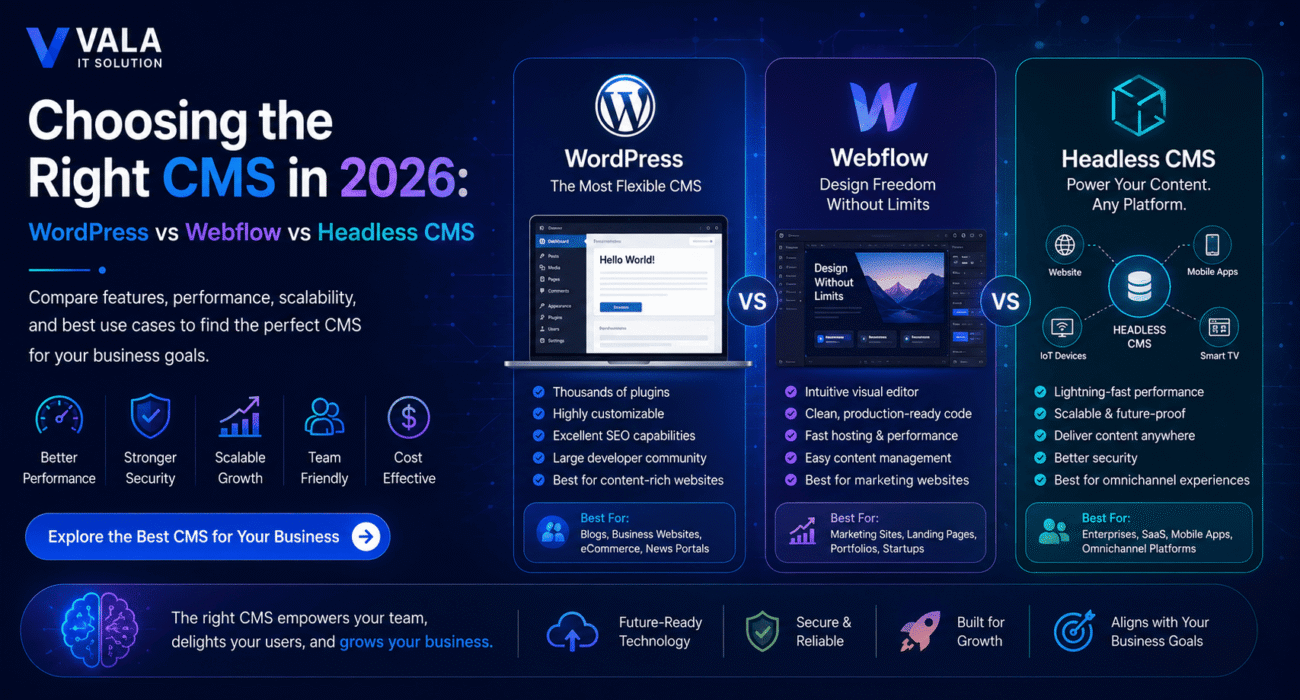
WordPress: The Most Flexible CMS
WordPress continues to dominate the web, powering over 40% of websites worldwide. Its popularity comes from its flexibility, large ecosystem, and massive community support.
Best For
- Business websites
- Blogs
- News portals
- Membership websites
- Educational platforms
- WooCommerce stores
- SEO-focused websites
Advantages
- Thousands of plugins available
- Highly customizable
- Excellent SEO capabilities
- Large developer community
- Cost-effective
- Supports almost every type of website
Challenges
- Plugin conflicts
- Requires regular updates
- Security depends on proper maintenance
- Performance can suffer with poor hosting or excessive plugins
Best Practice
Use managed hosting, trusted plugins, and regular maintenance to keep your WordPress website secure and fast.
Webflow: Visual Design Without Heavy Development
Webflow has become a favorite among designers and marketing teams because it combines visual design with content management.
Instead of relying heavily on developers, teams can build and update websites visually.
Best For
- Corporate websites
- Landing pages
- Portfolio websites
- Marketing websites
- Creative agencies
- Startups
Advantages
- Beautiful visual editor
- Clean generated code
- Fast hosting
- Easy content management
- Built-in animations
- Minimal maintenance
Challenges
- Monthly subscription costs
- Limited plugin ecosystem
- Less flexibility for highly customized applications
- Complex business logic requires custom development
Headless CMS: Built for Modern Digital Experiences
A Headless CMS separates content management from the website itself.
Content is delivered through APIs, allowing the same content to power:
- Websites
- Mobile apps
- Smart TVs
- Digital kiosks
- IoT devices
- Customer portals
Popular Headless CMS platforms include:
- Strapi
- Contentful
- Sanity
- Storyblok
- Directus
These are commonly paired with frameworks like:
- Next.js
- Nuxt
- React
- Vue
- Astro
Best For
- Enterprise websites
- SaaS platforms
- Large eCommerce businesses
- Multi-language websites
- Omnichannel publishing
- Mobile-first applications
Advantages
- Lightning-fast performance
- Excellent scalability
- Better security
- Flexible architecture
- Reusable content across platforms
- Future-proof development
Challenges
- Higher development costs
- Requires experienced developers
- More complex architecture
- Longer initial development time
Feature Comparison
| Feature | WordPress | Webflow | Headless CMS |
|---|---|---|---|
| Ease of Use | ⭐⭐⭐⭐⭐ | ⭐⭐⭐⭐⭐ | ⭐⭐⭐ |
| Design Flexibility | ⭐⭐⭐⭐ | ⭐⭐⭐⭐⭐ | ⭐⭐⭐⭐⭐ |
| SEO | Excellent | Excellent | Excellent |
| Performance | Good (optimized) | Very Good | Outstanding |
| Custom Development | Excellent | Limited | Excellent |
| Security | Good | Very Good | Excellent |
| Maintenance | Medium | Low | Medium–High |
| Best for Marketing Teams | Good | Excellent | Good |
| Scalability | High | Medium | Very High |
Which CMS Should You Choose?
Choose WordPress If:
- You need flexibility
- You want thousands of plugins
- SEO is a priority
- You want a cost-effective solution
- Your website relies heavily on content
Choose Webflow If:
- Your marketing team manages the website
- Visual design is your top priority
- You want minimal maintenance
- Your website doesn’t require complex functionality
Choose Headless CMS If:
- Performance is critical
- You serve content across multiple platforms
- Your business is rapidly growing
- You need maximum flexibility
- You’re building a modern web application
Key Factors to Consider
Before choosing any CMS, ask yourself:
Who will update the website?
Marketing team?
Content writers?
Developers?
How often will content change?
Daily publishing?
Weekly blogs?
Occasional updates?
What integrations do you need?
CRM
Payment gateways
ERP systems
Marketing automation
Analytics
AI tools
What’s your long-term budget?
Remember to consider:
- Hosting
- Development
- Maintenance
- Security
- Updates
- Third-party services
The cheapest CMS today may not be the cheapest to maintain over the next five years.
Future Trends in CMS (2026 and Beyond)
Modern CMS platforms are increasingly integrating AI and automation.
Emerging trends include:
- AI-assisted content creation
- Personalized user experiences
- Visual page builders
- Voice search optimization
- API-first architecture
- Headless commerce
- Automated SEO recommendations
- AI-powered translations
Businesses adopting these technologies can publish content faster and deliver more personalized digital experiences.
Final Thoughts
There is no universally “best” CMS—only the one that best aligns with your business goals, team, and technical requirements.
- WordPress remains the most versatile and budget-friendly option for content-rich websites.
- Webflow is ideal for visually stunning marketing websites that require minimal developer involvement.
- Headless CMS is the preferred choice for enterprises, high-performance applications, and omnichannel content delivery.
Rather than following trends, choose the platform that will support your business for years to come.
At Vala IT Solution, we help businesses evaluate, build, and maintain websites using WordPress, Shopify, Laravel, custom PHP, and modern headless technologies. Whether you’re launching a new website or planning a migration, we’ll recommend the solution that fits your goals—not just the latest trend.