
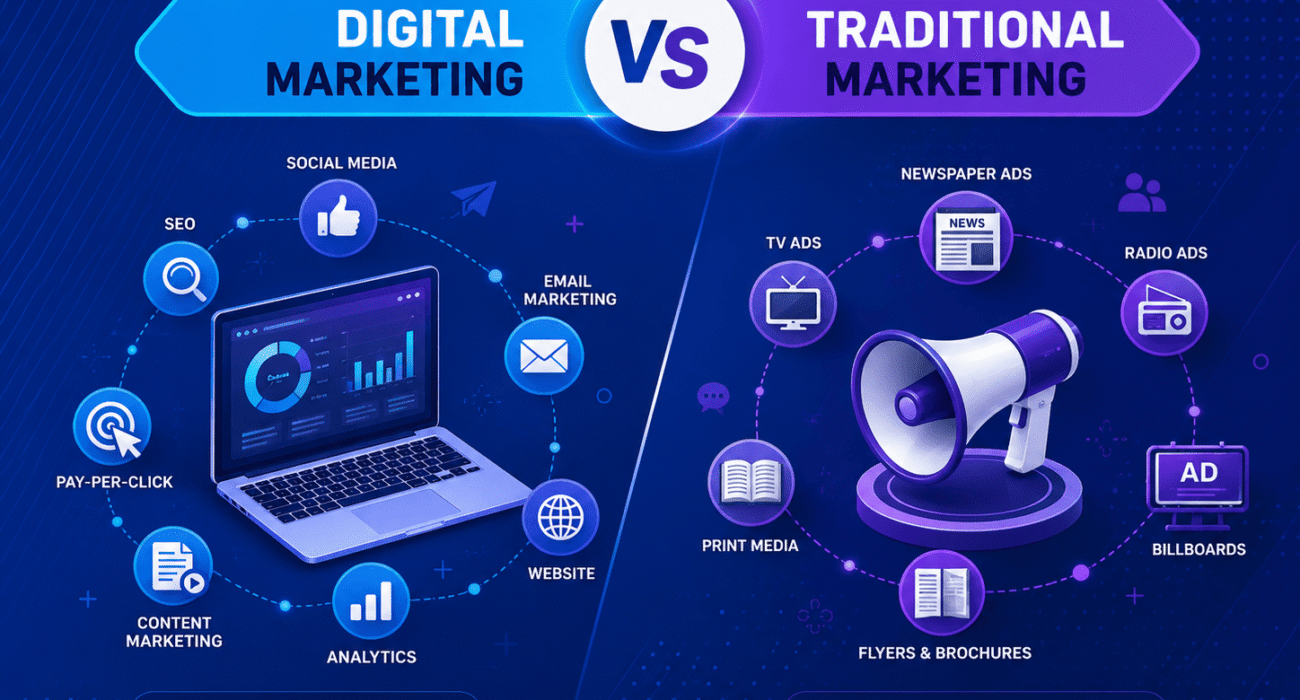
Marketing plays a crucial role in the success of any business. Whether a company is promoting its products online or offline, effective marketing helps attract customers, build brand awareness, and drive sales. As technology continues to evolve, businesses now have two primary approaches to reach their target audience: traditional marketing and digital marketing.
Traditional marketing includes conventional promotional methods that do not rely on the internet. These methods include newspaper advertisements, television and radio commercials, direct mail campaigns, billboards, flyers, telemarketing, trade shows, and in-person events.
Digital marketing, on the other hand, utilizes online platforms and technologies to promote products and services. Popular digital marketing channels include social media marketing, search engine optimization (SEO), email marketing, content marketing, pay-per-click (PPC) advertising, and mobile app marketing.
While both approaches have their advantages, understanding their differences can help businesses choose the most effective strategy for their goals.
Topics Covered
- Reaching a Global Audience
- Cost Effectiveness
- Brand Development
- Analytics and Performance Tracking
- Customer Interaction
- Business Size and Scalability
- Strategy Optimization
- Conclusion
Reaching a Global Audience
One of the biggest limitations of traditional marketing is its geographic reach. Small businesses often target local customers through newspapers, brochures, flyers, and local advertising channels. While effective for regional promotion, expanding beyond a specific location can be challenging and expensive.
Digital marketing removes these geographical barriers. Through websites, social media platforms, email campaigns, and search engines, businesses can connect with potential customers across the globe. This global reach allows even small businesses to compete in international markets with relatively low investment.
Traditional Marketing
- Primarily targets local or regional audiences
- Limited geographic reach
- Expansion can be costly
Digital Marketing
- Reaches customers worldwide
- Easy audience targeting
- Greater scalability and accessibility
Cost Effectiveness
Traditional marketing often requires substantial investment. Television commercials, radio advertisements, print media placements, and billboard campaigns involve production costs, media buying expenses, and ongoing management fees.
Digital marketing offers a more affordable alternative. Businesses can run highly targeted campaigns through social media, search engines, and email marketing with flexible budgets. This allows companies to maximize their return on investment while reaching the right audience.
Traditional Marketing
- Higher advertising costs
- Expensive production and distribution
- Limited budget flexibility
Digital Marketing
- Lower entry costs
- Budget-friendly advertising options
- Better return on investment
Brand Development
Building a strong brand requires consistent communication and visibility. Traditional marketing often faces limitations in terms of advertising space, duration, and frequency. A newspaper advertisement or television commercial provides only a limited opportunity to communicate a brand’s message.
Digital marketing provides businesses with multiple channels to build and strengthen their brand presence. Websites, blogs, social media profiles, videos, and email campaigns allow companies to engage with their audience continuously and share valuable content over time.
Additionally, customer interactions through likes, comments, shares, and reviews help increase brand visibility and credibility.
Traditional Marketing
- Limited communication opportunities
- Restricted ad space and airtime
- Less flexibility for content updates
Digital Marketing
- Continuous brand engagement
- Unlimited content opportunities
- Greater audience interaction and visibility
Analytics and Performance Tracking
Measuring the effectiveness of traditional marketing campaigns can be difficult. Businesses often rely on estimates and surveys to determine how many people saw an advertisement and how it influenced purchasing decisions.
Digital marketing provides access to detailed performance data in real time. Businesses can track website traffic, conversion rates, customer behavior, engagement metrics, and campaign performance instantly.
These insights help marketers make informed decisions and optimize their strategies for better results.
Traditional Marketing
- Limited performance tracking
- Difficult to measure ROI accurately
- Results often delayed
Digital Marketing
- Real-time analytics
- Detailed audience insights
- Accurate measurement of campaign performance
Customer Interaction
Traditional marketing typically offers limited opportunities for direct customer engagement. Although methods like telemarketing and live events allow interaction, they can be expensive and difficult to scale.
Digital marketing encourages two-way communication between businesses and customers. Through social media, live chat, email, and online communities, companies can engage directly with their audience, answer questions, gather feedback, and build stronger relationships.
Traditional Marketing
- Limited customer engagement
- One-way communication in most cases
- Less immediate feedback
Digital Marketing
- Direct interaction with customers
- Real-time communication
- Stronger customer relationships
Business Size and Scalability
Traditional marketing can be challenging for small businesses due to its high costs and resource requirements. Large advertising campaigns often require significant budgets and manpower.
Digital marketing creates a level playing field. Businesses of all sizes can establish an online presence, reach large audiences, and compete effectively without requiring massive investments.
Traditional Marketing
- Better suited for large budgets
- Higher operational costs
- Less accessible for startups
Digital Marketing
- Suitable for businesses of all sizes
- Cost-effective growth opportunities
- Easier scalability
Strategy Optimization
Successful marketing depends on continuous improvement. With traditional marketing, businesses often receive feedback long after a campaign has ended, making it difficult to adjust strategies quickly.
Digital marketing allows businesses to monitor performance in real time and make immediate changes when needed. Tools such as Google Analytics, social media insights, and marketing automation platforms provide valuable data that helps optimize campaigns for better outcomes.
Traditional Marketing
- Slow feedback cycles
- Limited opportunities for quick adjustments
- Higher risk of wasted budget
Digital Marketing
- Real-time performance monitoring
- Quick strategy modifications
- Improved campaign effectiveness
Conclusion
Both traditional and digital marketing have their strengths and can play important roles in a successful marketing strategy. Traditional marketing remains valuable for local outreach, brand recognition, and audiences that respond well to offline channels.
However, in today’s digital-first world, digital marketing offers greater flexibility, broader reach, lower costs, measurable results, and stronger customer engagement. Its ability to target specific audiences, track performance, and adapt quickly makes it an essential tool for modern businesses.
Ultimately, the best approach depends on your business goals, target audience, and available resources. Many successful companies combine both traditional and digital marketing strategies to maximize their reach and achieve long-term growth.